How to Start a Car Rental Business: The Short Answer
To start a car rental business, pick a rental model, run the numbers per car, form an LLC and get your local licenses and sales tax permit, buy commercial rental insurance, build a small fleet, write your rental policies, set up a way to take bookings and payments, and find your first renters. Most new agencies start with a handful of cars and add vehicles once each one is renting often enough to cover its own costs.
This guide walks through those nine steps in order, the way an independent agency actually has to do them. It focuses on a traditional car rental business in the US, meaning your own cars, your own customers and your own rental agreement. If you are planning a specialty fleet, we also have guides to starting an exotic car rental business and starting an RV rental business.
Before you start: this is a practical guide, not legal, tax or insurance advice. Licensing, rental taxes and insurance requirements vary by state, county and city. Confirm each step with your state’s revenue department, your DMV and an insurance broker who writes auto rental policies.
- Choose your rental model
- Run the numbers before you buy a car
- Form the business and get licensed
- Get commercial rental insurance
- Build your first fleet
- Write your rental policies and agreement
- Set up bookings, contracts and payments
- Find your first renters
- Track utilization from day one
Step 1: Choose Your Rental Model
Who you rent to decides almost everything that follows: which cars you buy, how long rentals last, what insurance you need and where your customers come from. Pick one model to start. You can add others once the first one is working.
| Model | Typical renter | What it takes |
|---|---|---|
| Traditional daily and weekly rental | Travelers, locals between cars, weekend trips | A visible location or delivery service, a booking website, and competitive daily rates |
| Insurance replacement | Drivers whose car is in the body shop after a claim | Relationships with body shops and adjusters, longer rentals, and billing that may go to an insurer instead of the driver |
| Long-term and monthly rental | Contract workers, people relocating, gig drivers | Recurring billing, tighter screening, and a plan for mileage and maintenance during long rentals |
| Specialty fleet (exotic, vans, trucks, RVs) | Events, moving, group trips, tourism | Higher vehicle cost, larger deposits and specialty insurance |
| Peer-to-peer platform (for example Turo) | The platform’s customers | A listing on someone else’s marketplace. The platform handles bookings and payments and keeps a share of each trip |
Many owners test demand on a peer-to-peer platform before building their own brand. That is a reasonable first step, but it is a different business: the platform owns the customer relationship, sets the rules and takes a cut. The rest of this guide covers running your own agency, where you keep the customer and the full rental rate, and carry the insurance, contracts and marketing yourself.
Step 2: Run the Numbers Before You Buy a Car
A rental car earns money only on the days it is out. Everything else about the business is a cost. So before you buy anything, work out what one car costs you per month and how many days it has to rent to cover that.
Startup costs to price out
- Vehicles: purchase price or down payment, taxes, title and registration.
- Insurance: the first premium or deposit on a commercial rental policy (Step 4).
- Business setup: LLC filing, licenses and permits, and a lawyer’s review of your rental agreement.
- Location: lot or office rent and deposit, or a delivery setup if you meet renters where they are.
- Equipment: GPS trackers, key lockboxes, cleaning supplies, and a phone line.
- Software and website: booking, contracts and payments (Step 7).
- Working capital: enough cash to cover several months of fixed costs while bookings build.
The monthly math for one car
Monthly profit per car = (daily rate × days rented) − (vehicle payment + insurance + maintenance reserve + cleaning + card fees + software and overhead share).
Here is how that works with illustrative numbers only. They are not a benchmark, so replace each one with your own quotes:
| Line | Example |
|---|---|
| Daily rate | $55 |
| Days rented this month | 18 |
| Revenue | $990 |
| Vehicle payment | $400 |
| Insurance | $250 |
| Maintenance and tire reserve | $80 |
| Cleaning | $60 |
| Card fees, software and overhead share | $50 |
| Left over | $150 |
In this example the car’s costs are $840 a month, so it needs 16 rental days just to break even at $55 a day. At 12 days it loses money. That is why the next number to watch after your daily rate is utilization: the share of available days a car is actually rented. Your pricing, your fleet size and your marketing all exist to push it up.
Step 3: Form the Business and Get Licensed
In most places there is no single license called a “car rental license.” Instead, you put together the registrations and permits your state and city require for a business that rents vehicles. Expect most of the following:
- A business entity. Most owners form an LLC with their state’s secretary of state, which separates business debts from personal assets. Title the cars to the business, not to yourself.
- An EIN. The IRS issues an Employer Identification Number for free. You need one to open a business bank account and, if you hire, to run payroll.
- A local business license. Your city or county issues this, sometimes called a business tax receipt.
- A sales tax permit. Vehicle rentals are taxable in most states, and many states, counties and cities add rental-specific surcharges or taxes on top. Register with your state revenue department and ask exactly which rental taxes you have to collect and report.
- Zoning and occupancy approval. If you run from a lot or storefront, confirm the zoning allows vehicle rental and that there is room to park your fleet.
- Vehicle registration. Some states have a separate registration class or fee for rental vehicles. Ask your DMV before you register the first car.
- Airport access, if you want it. Picking up renters at an airport usually requires a permit or concession agreement with the airport authority, and that comes with fees.
The quickest way to get a complete list is to call your state revenue department and your city’s business licensing office and tell them you are opening a vehicle rental business. Write down every permit they name and how often each one renews.
Step 4: Get Commercial Rental Insurance
Personal auto policies generally exclude cars rented to the public for a fee. You need a commercial policy written for auto rental, and it is often the hardest part of the launch for a new owner. Start asking for quotes before you buy cars, because the insurer may have rules about vehicle age, value and driver screening. Our guide to car rental business insurance covers each policy in more detail.
Coverages to ask a broker about:
- Commercial auto liability: injury and property damage claims arising from your vehicles, at or above your state’s minimum limits.
- Physical damage (collision and comprehensive): repair or replacement of your own cars after a crash, theft, vandalism or weather.
- General or garage liability: injuries and damage on your premises, such as a customer hurt on your lot.
- Umbrella or excess liability: extra limits above your primary policies.
Two points worth raising with your broker. First, a federal law known as the Graves Amendment generally protects rental companies from being held liable simply because they own a car a renter crashed, as long as the company was not itself negligent. That does not replace liability insurance, and your state still sets minimum coverage. Second, if you plan to sell renters a damage waiver or supplemental liability coverage at the counter, ask how your state regulates those products before you add them to your price list.
Step 5: Build Your First Fleet
Start with cars that are cheap to own and easy to rent: reliable economy and midsize sedans, small SUVs or minivans, depending on who you rent to. Early on, a paid-off car that rents steadily is worth more than a newer one with a large monthly payment.
- Buy or finance with the break-even math in hand. A lower purchase price lowers the number of rental days each car needs to cover itself.
- Check open recalls before every rental. Federal law bars rental companies from renting out a vehicle with an open safety recall until it is repaired. Look up each VIN on NHTSA’s recall site.
- Plan maintenance from the start. Oil changes, tires and brakes come around quickly on a car that rents most of the month. Every day in the shop is a day it cannot earn. Our fleet management page covers how to schedule it.
- Decide on GPS tracking. Trackers help with recovery and mileage disputes. Disclose them in your rental agreement, since some states limit how rental companies may use location data.
Step 6: Write Your Rental Policies and Agreement
Your rental agreement is what lets you collect when a car comes back late, damaged or with a toll bill attached. Write it before your first rental and have a local attorney review it. At a minimum, decide:
- Minimum renter age and any young-driver fee
- Accepted driver licenses and how you verify them
- Security deposit or card hold amount
- Mileage allowance and the per-mile charge above it
- Fuel or EV charge return policy
- Who pays tolls, parking tickets and camera violations, plus your admin fee
- Late return, extension and cancellation rules
- Additional drivers, smoking, pets and out-of-state travel
- How damage is documented at pickup and return
Our guide to what a car rental agreement should include goes clause by clause. Timestamped check-out and check-in photos, together with a signed agreement, are what turn a damage dispute into a straightforward charge.
Step 7: Set Up Bookings, Contracts and Payments
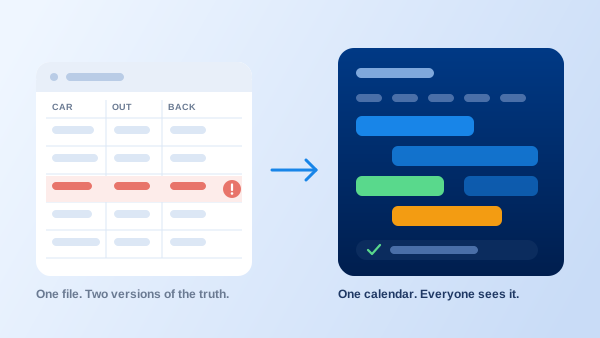
With one or two cars, a calendar and a spreadsheet can work. They usually stop working at the first double booking, or the first time a renter extends by text and nobody updates the sheet. We compare the two honestly in car rental software vs. Excel.
Whatever you use, a new agency needs these from day one:
- Online booking with live availability, so customers can reserve without calling
- Rate rules for weekends, weekly rentals and seasons
- Digital rental agreements with e-signatures
- Driver license scanning at pickup
- Payments and deposits taken online or at the counter
This is what we build. Car Rental Solutions starts at US$69.95 a month plus a one-time US$197 setup fee, and includes a booking form for your website, rate management, e-signed contracts and online payments. There is a 14-day free trial. See car rental software for small business for what each plan covers, or how much car rental software costs to compare other vendors.
Step 8: Find Your First Renters
New agencies rarely win on price against the national brands. They win on local relationships and convenience.
- Google Business Profile. Set it up with your real address or service area, hours and photos of the actual cars. Ask every early renter for a review.
- A website that takes bookings. A phone number alone loses renters who book at night. A car rental website with a booking engine lets them reserve and pay on the spot.
- Body shops and insurance adjusters. Drivers whose cars are being repaired need a replacement for days or weeks. Visit the shops within a short drive of your lot.
- Hotels, dealerships and employers. Front desks, service departments and HR offices all field requests for cars.
- Repeat renters. Keep every customer’s contact details and reach out before holidays and your busy season.
Step 9: Track Utilization From Day One
Once cars are renting, three numbers tell you whether the business is working:
- Utilization: days rented divided by days available, per car and across the fleet.
- Average daily rate: rental revenue divided by days rented.
- Revenue per car: what each vehicle brings in per month, compared with its monthly cost from Step 2.
A car that sits below its break-even days month after month is a candidate to sell or re-price. If every car is booked solid, it may be time to raise rates or add a vehicle. Our guides to improving fleet utilization and car rental dynamic pricing cover both moves.
Is a Car Rental Business Profitable?
A car rental business can be profitable, but the margin on each car is thin and depends mostly on how many days the car rents each month. The costs of owning a car (payment, insurance, maintenance) run every day, while revenue comes only on rental days. So the agencies that do well keep utilization high, buy cars at prices their rates can carry, and collect everything the agreement allows: damage, tolls, fuel and late fees.
The fastest way to answer the question for your own market is the one-car math in Step 2, using real insurance quotes and the daily rates competitors near you charge.
Frequently Asked Questions
It depends mostly on how many cars you start with and whether you buy them outright or finance them. The other startup costs are commercial insurance, business registration and permits, a lot or delivery setup, a booking system, and a few months of working capital. Price each line with real quotes. The monthly break-even math in Step 2 tells you how many cars your budget can support.
Yes. Many owners start with one or two cars, often on a peer-to-peer platform to test demand. To rent that car under your own brand, you still need a business entity, commercial rental insurance and a rental agreement. Insurance is usually the hardest part with a very small fleet, so get quotes first.
Usually you need several registrations rather than one license: a business entity, an EIN, a local business license, a state sales tax permit for rental taxes, and in some states a rental vehicle registration class. Airport pickups typically need a separate permit. Your state revenue department and city licensing office can give you the full list.
A peer-to-peer platform is a lower-risk way to test demand, because it brings the customers and handles payments. It also keeps a share of every trip and owns the customer relationship. Running your own agency means more setup (insurance, contracts, a website), but you set the rules, keep the full rate and build repeat business under your own name.
At minimum: online booking with live availability, rate rules, digital rental agreements with e-signatures, driver license capture and payment processing. Car rental software combines these in one system, and most vendors offer a free trial so you can set it up before your first rental.