
Business Growth
How Much Does Car Rental Software Cost? A Practical Pricing Guide
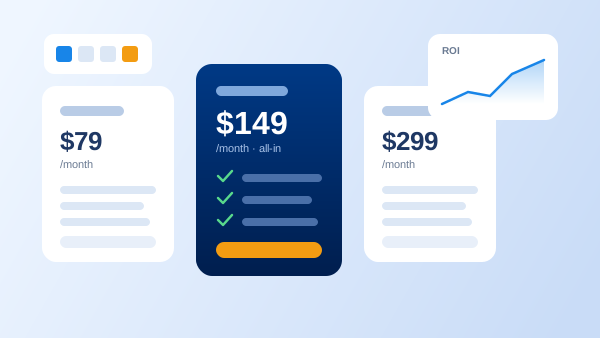
Ask five vendors what car rental software costs and you'll get five answers that can't be compared: a monthly fee here, a per-booking commission there, a "contact us" wall somewhere else. This guide breaks down the real pricing models, what actually drives the price, the hidden fees that surprise operators after signing, and a simple way to judge whether any system pays for itself.
The four pricing models you'll run into
1. Monthly subscription (SaaS)
The standard today. You pay a flat monthly fee for the platform — reservations, fleet, agreements, and ideally your booking website — usually tiered by fleet size or locations. Predictable, scales with you, no servers to maintain. This is how modern car rental software is sold.
2. Per-booking commission
Instead of a flat fee, the vendor takes a percentage or fixed amount from every reservation. It feels low-risk at first, but do the math at your busy-season volume: a commission model that costs less than a subscription in February can cost multiples of it in July. Growth makes it worse, not better.
3. Per-vehicle pricing
Some platforms charge per vehicle per month. Fair for small fleets, but watch the total as you add cars — and check whether vehicles parked for maintenance still count toward the bill.
4. One-time license (legacy)
Installed software with a large upfront license plus annual "maintenance" fees. The sticker price hides what you'll pay for hosting, backups, updates, and eventually a forced upgrade. This model is disappearing for good reasons.
What actually drives the price
- Fleet size and locations. More vehicles and branches mean higher tiers — multi-location control is genuinely more complex to deliver.
- Booking website included or not. The single biggest difference between quotes. A system with an integrated reservation system and booking website replaces a separate web project that would cost thousands on its own.
- Feature depth. E-sign agreements, rate engines that handle seasons and extras, maintenance tracking, multilingual booking — each replaces a separate tool or manual process.
- Onboarding and support. Included training and setup versus billed-by-the-hour "professional services".
Hidden costs to ask about before signing
Get the all-in first-year number in writing. Specifically ask about: setup or onboarding fees; charges for "customizing" basic rental pricing rules; website hosting billed separately; payment gateway markups on top of your processor's rate; support tiers where phone help costs extra; and per-user fees that punish you for adding counter staff. Any one of these can quietly double a low advertised price.
How to compare quotes: 5 steps
- Normalize to one number. Ask every vendor for the total first-year cost with website, onboarding, and support included — then divide by 12.
- Project the commission math. For per-booking models, multiply the fee by your July booking count, not your January one.
- Check what "included website" means. A real booking site with live availability and your branding, or a widget on a template?
- Confirm the go-live cost. Data import, fleet setup, rate configuration, training — included or billed?
- Compare against captured revenue. Divide the monthly price by your average booking value. That's how many bookings the software needs to win you each month to break even.
Simple, transparent pricing
Website, reservations, e-sign agreements, and fleet management in one plan — see exactly what's included, with no setup surprises.
See pricing Book a free demoThe ROI question that matters more than price
Cheap software that can't take bookings at 11 pm is expensive. The right comparison isn't plan A versus plan B — it's the monthly fee versus what an integrated system captures and saves: after-hours reservations your closed counter currently loses, double bookings that never happen, agreements signed in minutes instead of re-typed at the desk, and admin hours you stop spending on spreadsheets. For most independent agencies, two to three additional bookings a month covers the software — everything past that is margin.
Fleet size changes the math too: review the features included in each plan and start with the tier that matches your operation today. If you run a small fleet, our guide to choosing software for a small agency covers where to spend and where to save.
The takeaway
Expect roughly $50–$500+ per month depending on fleet size and scope, be suspicious of low prices that exclude the booking website, and judge every quote by one number: the all-in first-year cost divided by the bookings it will capture. Software priced fairly pays for itself in its first weekend of after-hours reservations.
Car rental software pricing FAQs
What does car rental software cost per month?
Most cloud-based car rental systems fall between roughly $50 and $500+ per month depending on fleet size, locations, and whether a booking website is included. Per-booking commission models exist too, but they get expensive as your volume grows. Always compare the total monthly figure with everything included: website, reservations, agreements, and support.
Are there setup or onboarding fees?
Some vendors charge one-time setup, training, or "customization" fees that can exceed the first year of subscription. Ask for the all-in first-year cost in writing. Purpose-built platforms should include onboarding, fleet configuration, and website setup in the plan.
Is per-booking commission pricing cheaper than a subscription?
Commission pricing looks cheap at low volume, but it scales against you: the more you grow, the more you pay. A flat subscription becomes cheaper per booking as volume rises, and it keeps your margin predictable in high season.
Does the price include a booking website?
Not always — and it's the most important line item to check. Some vendors sell back-office software only, leaving you to buy and integrate a website separately. An integrated booking website is where after-hours reservations come from, so a plan that includes it usually wins on total cost.
How do I know if the software pays for itself?
Divide the monthly price by your average booking value. If the answer is two or three bookings, that's typically what one month of 24/7 online reservations captures on its own — before counting saved admin hours, prevented double bookings, and faster counter service.