
Car Rental Business Insurance: The Short Answer
A car rental business needs a commercial auto policy written for rental use. It should include liability coverage for injuries and damage your renters cause, physical damage coverage for your own cars, general or garage liability for your premises, and usually an umbrella policy on top. A personal auto policy will not do the job, because personal policies generally exclude cars rented to the public for a fee.
Insurance is often the hardest part of opening an agency and one of its largest monthly costs. This guide explains each coverage in plain terms. It also covers what renters can bring or buy at the counter, what state law lets you recover after damage, and how to prepare for a broker meeting so your quotes come back faster. It is written for independent agencies in the US. If you are still at the planning stage, start with how to start a car rental business.
Not insurance advice: Car Rental Solutions is a software company, not an insurer or broker. Coverage rules, required limits and what you may sell renters vary by state. Confirm every point here with a licensed broker who writes auto rental business, and with your state insurance department.
Why a Personal Auto Policy Won’t Cover Rentals
Personal auto policies are priced for one household driving its own cars. Most exclude vehicles used “for hire” or rented to others for a fee. If a renter crashes a car that is only covered by a personal policy, the insurer can deny the claim, and you are left paying for the car, the other driver’s damage and any injury claim.
Peer-to-peer platforms such as Turo provide their own protection plans for trips booked through the platform. That protection applies to those trips only. The moment you rent the same car directly to a customer under your own agreement, you need your own commercial rental coverage.
The Four Coverages a Rental Agency Needs
| Coverage | What it pays for | Example claim |
|---|---|---|
| Commercial auto liability | Injury and property damage to others caused by your vehicles | A renter rear-ends another car and the other driver is injured |
| Physical damage (collision and comprehensive) | Repair or replacement of your own cars after a crash, theft, vandalism, fire or weather | A rental is stolen from a hotel parking lot |
| General or garage liability | Injuries and property damage at your location that are not caused by driving | A customer slips on your lot during pickup |
| Umbrella or excess liability | Extra limits once your primary liability policy is used up | A serious crash produces a claim larger than your auto liability limit |
Commercial auto liability
This is the core policy, and every state requires some version of it. Your state sets minimum financial responsibility limits, but the minimum is a legal floor, not a recommendation. Ask your broker what limit makes sense for your fleet size and the areas where your cars are driven, and how much an umbrella would cost to add on top.
Physical damage
Collision covers your car when it hits something. Comprehensive covers most other damage, such as theft, vandalism, hail and flood. The deductible you choose drives the premium. A higher deductible lowers the premium, but you pay more out of pocket on every claim, so only raise it if your cash reserves can absorb several claims close together.
General or garage liability
Auto policies cover your cars on the road. Premises liability covers the office, the lot and the counter. If you wash, fuel or move cars on site, ask whether you need garage liability rather than a standard general liability form.
Umbrella or excess liability
A single serious injury claim can exceed a primary auto limit. An umbrella adds a layer of liability coverage above your auto and general liability policies, usually for less per dollar of coverage than raising the primary limits.
Does the Graves Amendment Protect You?
Partly. The Graves Amendment is a federal law (49 U.S.C. § 30106). It generally bars claims against a rental company based only on the fact that it owns the car a renter was driving, provided the company was not itself negligent and was not engaged in criminal wrongdoing.
It does not protect you from claims that you were negligent, such as renting to a driver whose license you did not check, or renting out a car with bad brakes or an open safety recall. It also does not replace the liability insurance your state requires. What it means in practice is that your own procedures matter: license verification, maintenance records and recall checks are part of your defense.
What Renters Bring and What You Can Offer
Three different things get called “rental insurance” at the counter. They work differently, and some are regulated by the state.
The renter’s own coverage
Many renters have a personal auto policy that extends to rental cars, or a credit card with rental car benefits. Both vary widely. Some exclude certain vehicle types or long rentals, and card benefits are often secondary to other insurance. If you accept a renter’s own coverage, record the insurer and policy number on the rental agreement. Your own policy still needs to respond when theirs does not.
Damage waivers (CDW or LDW)
A collision or loss damage waiver is usually not insurance. It is a contract term in which you agree not to charge the renter for damage to your car if they pay a daily fee. Several states regulate how waivers are sold, what they may cost and what disclosures you must give. Check your state’s rules before you set a waiver price.
Insurance products sold at the counter
Supplemental liability, personal accident and personal effects coverage are insurance products. Some states require the rental company, and in some cases counter staff, to hold a limited lines license to offer them. Other states do not require a license. If you want to offer these products, ask your broker which carrier would underwrite them and what licensing your state requires.
What You Can Recover From Renters After Damage
When a renter without a waiver damages a car, your rental agreement decides what you bill, and state law may cap it. A review by Auto Rental News of nine states (California, Illinois, Indiana, Iowa, Missouri, Nevada, New York, Utah and Wisconsin) found they limit what rental companies can recover from renters:
- Repairs: generally recoverable at actual cost, up to the car’s fair market value if it is totaled.
- Loss of use: the rental income lost while the car is in the shop. Allowed in some of those states, but prohibited in California, New York and Wisconsin.
- Administrative fees: permitted in several of those states, but capped. California’s cap is tiered by the amount of damage.
States without a specific statute generally follow ordinary contract and damages law. Either way, you can only bill what you can prove. Timestamped photos at check-out and check-in, a signed agreement and the repair invoice are what turn a disagreement into a charge the renter or their insurer pays. Our guide to what a car rental agreement should include covers the damage clause in detail.
What Affects Your Premium
We don’t publish premium figures, because they depend on your state, your fleet and the carrier. These are the factors insurers commonly ask about, and the ones you have some control over:
- Vehicle type and value: economy sedans cost less to insure than luxury or high-performance cars.
- Fleet size and garaging location: where the cars are kept overnight and the areas they are driven in.
- Renter screening rules: minimum age, license checks, and whether you rent to drivers with recent violations.
- How the cars are used: daily rental, insurance replacement, long-term rental, or cars rented to rideshare or delivery drivers.
- Claims history and years in business: new agencies have no record yet, so written procedures carry more weight.
- Deductibles and limits: the trade-off between premium and out-of-pocket risk.
- Safety equipment: some insurers ask about GPS tracking and immobilizers.
How to Get Quotes Faster
Few insurers write auto rental business, so work with a broker who already places it. Examples of insurers that market auto rental coverage include Lancer, Zurich and GMI. Availability depends on your state and fleet, and we have no relationship with any of them. Bring the following to the first meeting:
- A vehicle list with year, make, model, VIN and value
- Where the cars are garaged overnight
- Your rental model and typical rental length
- Your renter requirements: minimum age, license rules, deposits
- A copy of your rental agreement
- How you document vehicle condition at pickup and return
- Any prior insurance and claims history
Then ask each broker the same questions: which limits they recommend and why, what the deductible options cost, whether garage liability is included, how renter-caused damage claims are handled, what happens when a renter’s own insurance is primary, and whether the policy has rules about renter age or vehicle age.
Records That Protect You at Claim Time
Insurance pays claims, but your records decide how quickly and how completely. Keep these for every rental:
- A signed rental agreement with the damage, waiver and insurance terms the renter accepted
- A scan or photo of the driver’s license for every authorized driver
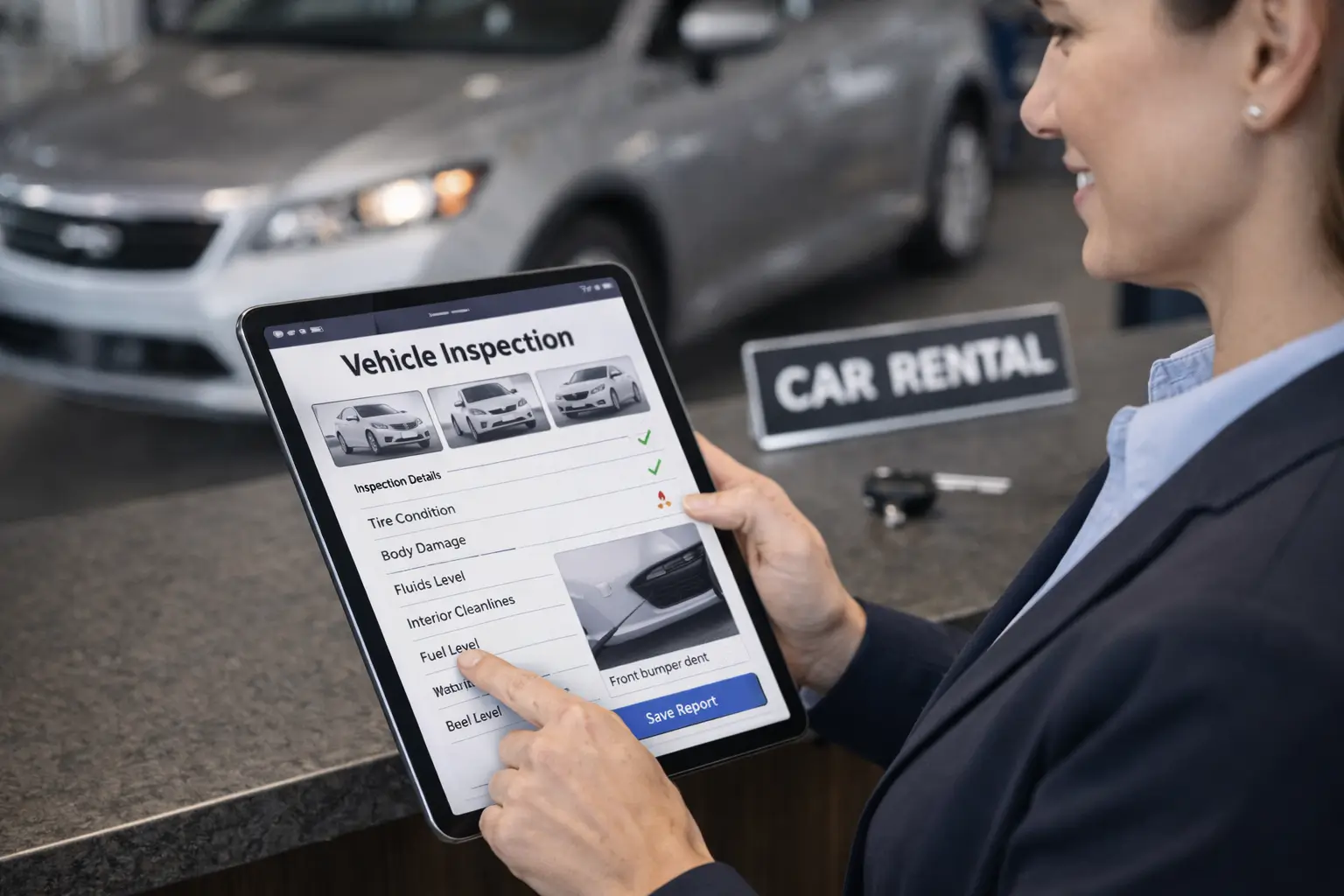
- Timestamped photos of all four sides, the interior, the fuel level and the odometer at check-out and check-in
- The renter’s own insurance details, if they declined your waiver
- Maintenance and recall-check records for the vehicle
Car Rental Solutions keeps these together on each reservation: e-signed rental agreements, driver license scanning and the renter’s details, all in one record you can pull up when an adjuster calls. Plans start at US$69.95 a month, with a 14-day free trial.
Frequently Asked Questions
It depends on your state, your vehicles, your fleet size, your renter screening rules, your deductibles and your claims history, so there is no reliable single figure. Get written quotes from at least two brokers who place auto rental business, and use the premium per car in your break-even math before you buy vehicles.
Generally no. Personal auto policies typically exclude vehicles rented to others for a fee, so a claim during a rental can be denied. You need a commercial auto policy written for rental use.
No. A peer-to-peer platform’s protection plans apply to trips booked through that platform. Cars you rent directly to customers under your own agreement need your own commercial rental coverage.
Usually not. A damage waiver is a contract term in which the rental company agrees not to charge the renter for damage in exchange for a fee. Several states regulate how waivers are sold and priced. Supplemental liability and personal accident coverage, by contrast, are insurance products, and some states require a limited lines license to sell them.
Many agencies ask for proof of insurance or require renters to buy a waiver if they have none. Put the requirement in your rental agreement and record the renter’s insurer and policy number. Confirm with your broker how your own policy responds if the renter’s coverage turns out not to apply.