Car Rental Software vs Excel: The Short Answer
It is 9:40 on a Saturday morning. A walk-in wants the silver Corolla for the weekend, and while you are writing him into the sheet, your partner is on the phone confirming that same car to a customer for the same two nights. Both people now have a booking. One of them is going to arrive to an empty space.
That moment, not fleet size, is what decides this question. If you run fewer than about five vehicles, from one location, with one person making every booking, Excel is enough — and buying car rental software now would solve a problem you do not have. We sell rental software, and that is still the honest answer.
What changes it is the day availability starts living in two places at once: the sheet and someone's memory, the sheet and a phone log, the sheet and a website form. From there, a double booking stops being a risk you manage and becomes an event you are waiting for.
What Excel Genuinely Does Well
Most arguments against the spreadsheet are made by people selling the alternative, so it is worth being fair to it.
Excel costs nothing you are not already paying, and you know how to use it. It bends to your business rather than the other way round — no vendor decides how your winter weekly rate has to work. No training, no onboarding call, no migration. It works when the internet does not. And for a fleet you can hold in your head, the sheet is just the written version of what you already know, which makes it fast and accurate.
That is why spreadsheets run rental agencies for years, and why "you should be on software" lands as a sales line rather than advice. For a small enough operation, the sheet is not a compromise. It is the right tool.
"The spreadsheet does not fail because it is a spreadsheet. It fails the day a second person needs to know what it says, at the moment you are changing it."
Five Points Where Excel Stops Paying
1. The second calendar
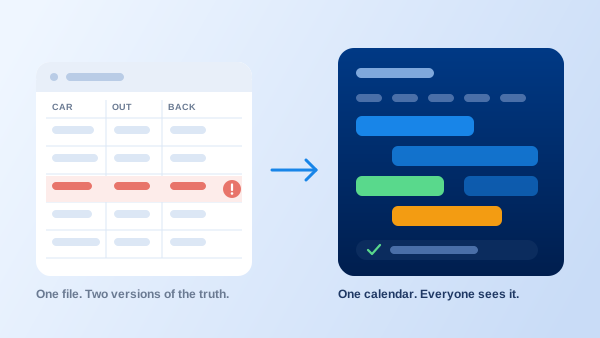
The Saturday morning above is the whole problem in one scene. One sheet and one person means no conflict; add a partner taking weekend calls, or an enquiry form on your site, and availability now exists in two places that update at different times. Every double booking starts here, and it arrives long before fleet size does — three cars with two people answering the phone has the problem, ten cars run by one person may not. Our guide to preventing double bookings covers why one shared calendar is the only real fix.
2. Bookings that arrive when nobody is at the desk
A family lands at 9pm, searches on a phone in the arrivals hall, and books the first agency whose site lets them finish. Your sheet is on a laptop at the office. You never learn that booking existed — it does not show up in the sheet, the bank, or a complaint. It is a vehicle-day that quietly did not sell, which is why this is the most expensive item on this list and the least visible.
3. Questions about the past
Your insurer asks for last year's utilization by vehicle class. The answer is spread across twelve monthly tabs with columns that changed in March, so you rebuild it by hand over an afternoon — and it is stale a week later. Most operators stop asking the question rather than keep paying for the answer, and that is the real loss: the compact that sat idle all winter keeps sitting there.
4. No record of who changed what
A customer disputes the daily rate on their invoice. Your counter staff are certain they quoted the winter rate; the sheet shows the summer one, and nothing shows who edited the cell or when. With one person that is tolerable. With staff, every disagreement becomes one person's word against another's.
5. Documents that live somewhere else
A damage claim arrives six weeks after the return. The signed agreement is in a folder, the licence photo is on a phone that has since been replaced, and the check-out pictures are in a message thread. Reassembling that file takes an hour, and if one piece is missing you absorb the cost — the same argument behind digital inspections over paper checklists.
Six Questions to Test Your Own Operation
Forget vehicle counts for a moment and answer these honestly.
-
1
Does more than one person take bookings?
If yes, you already have two calendars, whatever the sheet says.
-
2
Do customers try to book outside working hours?
If you do not know, that is the answer — a spreadsheet cannot report demand it never captured.
-
3
Have you had a double booking in the last year?
One is an accident. Two is a system telling you something.
-
4
Can you name your worst-earning vehicle last quarter in under a minute?
If it takes an afternoon, you are not measuring it — and you are probably still paying insurance on a car you should have sold.
-
5
Do you operate from more than one location?
Two branches on one sheet is the configuration that breaks soonest.
-
6
How many hours a week go into maintaining the sheet?
Count honestly, then put your own hourly value against it. That number is the real comparison, not the subscription price.
Nought to one yes: stay where you are. Back the file up somewhere that is not one laptop, and revisit in six months.
Two to three yes: you are at the edge. Software would pay for itself, but nothing is on fire. Price it properly before you move — our guide to what car rental software costs covers what to budget.
Four or more yes: the sheet now costs more than it saves, and has for a while. The question is no longer whether, but which.
What Changes When You Move Off Excel
The calendar becomes one thing
Website, counter and phone read and write the same availability, so the Saturday morning conflict cannot physically happen. That removes the category, not just the frequency.
The night shift starts selling
The 9pm booking completes itself while you sleep, because the calendar is live rather than a file on a laptop. Those vehicle-days used to go to whoever answered first.
Reports stop being projects
Utilization, revenue per vehicle and idle days are queries against data you already enter. That is what makes managing utilization realistic rather than aspirational.
The paperwork attaches to the rental
Agreement, licence, inspection photos and payment sit on the booking record, so the six-week-old damage claim is one screen instead of one hour.
If the Answer Is "Not Yet"
Staying on Excel is a legitimate decision, and worth making properly rather than by default. Back the file up somewhere that survives a dead laptop. Keep one sheet as the single source of truth and resist the second copy. Write your rate rules down so they are not only in your head. Then set a date six months out to run the six questions again, because the threshold tends to arrive quietly.
If budget is the real constraint rather than need, read free car rental software first — it covers where a limited free tool ends up more restrictive than the spreadsheet it replaced. And if what broke first was the fleet side rather than bookings, car rental fleet management software solves that half on its own. For smaller operations weighing the whole question, software built for small rental businesses is the right starting point rather than an enterprise platform.
Frequently Asked Questions
Yes, and many operators do. Excel handles a small fleet with a single calendar, a handful of rates, and one person making the bookings. It stops working when more than one person needs the same live view, when bookings arrive while nobody is at the desk, or when you need to answer questions about the past rather than the present.
Below roughly five vehicles with one person handling bookings, a spreadsheet is usually the right tool and software is premature. The number itself matters less than the conditions: one calendar keeper, one location, and no bookings arriving outside working hours.
The practical trigger is the second calendar. The moment availability exists in two places — a sheet and someone's memory, or a sheet and a phone log — double bookings become a matter of time. A second location, a second person taking bookings, or a website that accepts reservations all create that second calendar.
The costs are real but indirect: vehicle-days lost to bookings nobody could take after hours, the occasional double booking and the customer it loses, hours spent rebuilding reports that should be a click, and no reliable record of who changed a rate or when. None of it appears as a line item, which is exactly why it runs for years.
Usually yes for vehicles, customers, and rates, which are the three lists worth bringing across. Historical bookings are often better left in the spreadsheet as an archive than migrated, since the effort of cleaning years of inconsistent rows rarely pays back.
Not automatically. A free tier with a real availability calendar is a genuine step up from a sheet, but a limited free tool can be more restrictive than the spreadsheet it replaces. Judge it on whether it gives you one shared live calendar, not on the price.