The Most Expensive Mistake at the Rental Counter
Two customers, one car. One of them booked by phone on Tuesday; the other booked on your website Wednesday night. Both received a confirmation. Both showed up. Now someone at your counter has to tell a customer with a confirmation email that the vehicle they reserved does not exist — often at the start of their holiday, often with their family standing next to them.
A double booking is not just an awkward conversation. It's a refund, often a costly replacement vehicle from a competitor, and a one-star review that outlives the incident by years. Worse, it's almost never a one-off: if your booking process allowed it once, it will allow it again in your next busy week — exactly when you can least absorb it.
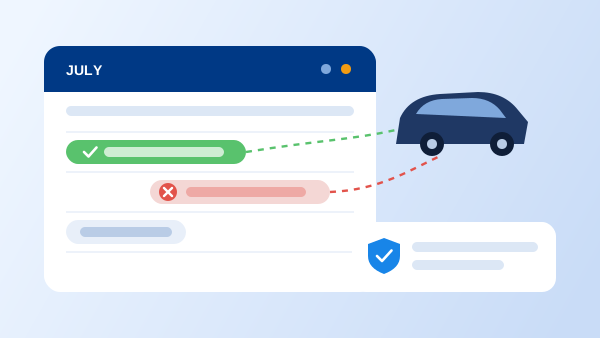
The good news is that double bookings are a completely solvable problem. They are not caused by bad staff or bad luck. They are caused by a booking process where availability lives in more than one place. Fix that, and overbooking becomes structurally impossible.
What Actually Causes Double Bookings
Availability that lives in more than one place
The root cause behind nearly every overbooking: your website says one thing, your spreadsheet says another, and the whiteboard behind the counter says a third. The moment availability is recorded in two systems, those systems will eventually disagree — and each disagreement is a double booking waiting for a customer to find it.
Manual entry gaps
A phone booking scribbled on a notepad "to enter later" leaves a window — sometimes minutes, sometimes hours — during which the same vehicle is still bookable online. Busy periods widen that window precisely when demand is highest. The overlap isn't a coincidence; it's built into the process.
No turnaround buffer between rentals
A car returned at 10:00 and rented again at 10:00 is a double booking in slow motion. Cleaning, refueling, and the return inspection all take time. If your calendar doesn't reserve that preparation window automatically, back-to-back bookings will collide at the counter even though the dates technically "fit."
Maintenance that doesn't block the calendar
A vehicle in the shop with a booking against it is functionally a double booking — the customer and the mechanic have both been promised the same car. If out-of-service status doesn't immediately remove a vehicle from sale, your fleet management and your reservations are working against each other.
Confirmation-later workflows
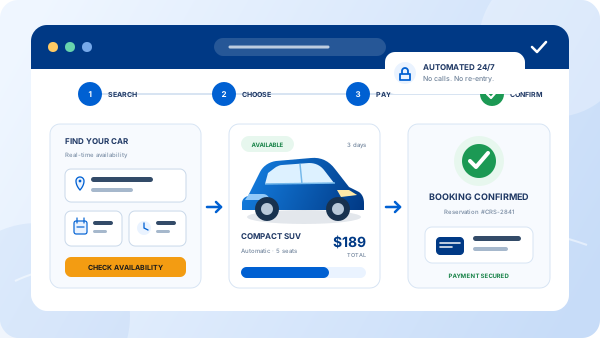
Booking forms that merely send you an email request — leaving the customer "pending" until you confirm manually — create hours of ambiguity during which the same dates can be sold twice. In 2026, a reservation should confirm and block the vehicle in the same second.
The Fix: One Calendar, One Source of Truth
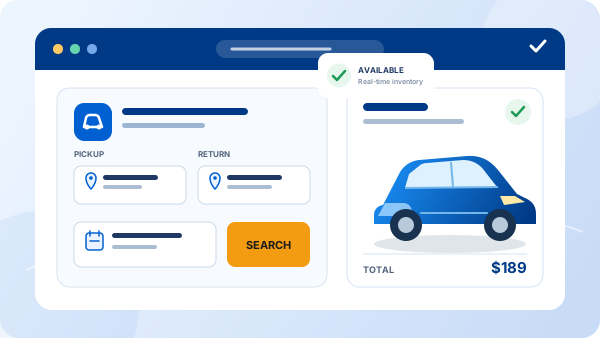
Every reliable fix for double bookings is a version of the same principle: one real-time availability calendar that every booking channel reads from and writes to. That is precisely what a purpose-built car rental reservation system provides.
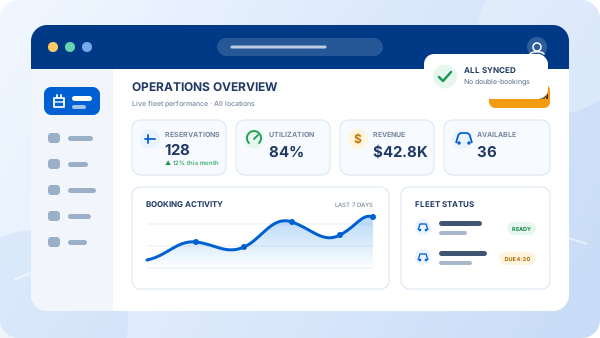
When your website, your counter, and your phone bookings all commit to the same calendar, a reservation instantly blocks that vehicle for those dates — including preparation time — and the vehicle disappears from sale everywhere at once. There is no window for a second customer to slip through, because there is no second copy of the truth. Real-time availability management stops being a discipline your staff must maintain and becomes something the system simply enforces.
Notice what this rules out. It rules out "being more careful" as a strategy — care doesn't scale, and your best employee's day off shouldn't be a risk factor. It rules out reconciliation routines, where someone compares the website to the sheet every evening: reconciliation finds conflicts after they're created, which means after two customers already hold confirmations. And it rules out anything that depends on the phone booking being typed in "soon." The only version that works is the one where there is nothing to reconcile, because there was only ever one calendar.
"Double bookings aren't a staffing problem. They're an architecture problem — and architecture problems have permanent fixes."
How to Make Double Bookings Impossible: 5 Steps
-
1
Put every booking channel on one system
Website, phone, email, walk-in — every reservation gets entered directly into the same platform, at the moment it's made. No notepads, no "I'll add it tonight." If a booking isn't in the system, it doesn't exist.
-
2
Let the website read live availability
Your booking engine must show only vehicles that are genuinely free for the requested dates, and confirm instantly. If a platform requires you to approve bookings manually, it isn't preventing double bookings — it's delaying them.
-
3
Configure turnaround buffers
Set a preparation window per vehicle or category — the time you need for cleaning, refueling, and inspection between rentals. The calendar then keeps that gap free automatically on every booking.
-
4
Block vehicles for maintenance in the same calendar
Service, repairs, and inspections should be scheduled as calendar blocks that remove the vehicle from sale — not tracked in a separate maintenance sheet that the booking side can't see.
-
5
Audit for stray channels
Once a quarter, ask: is there any way a booking can reach us without touching the system? A partner who texts reservations, a second location with its own sheet, a legacy form on an old page. Close every side door you find.
What Changes When Overbooking Is Off the Table
You can sell your calendar with confidence
When you trust your availability, you can push for full occupancy in high season instead of quietly holding vehicles back "just in case." That safety margin you keep today is unsold inventory — reclaiming it is pure revenue.
Your reviews stop carrying avoidable damage
A double booking is one of the few operational failures customers reliably write reviews about. Eliminating them removes your worst category of one-star review at the source.
Counter handovers get faster
No more cross-checking the sheet against the website before handing over keys. The system already agrees with itself, so pickup becomes a signature and a handover.
Staff stop firefighting
The hours spent untangling conflicts, calling customers to reschedule, and sourcing replacement vehicles go back into service and sales. Calm counters are also cheaper counters.
Growth stops multiplying risk
More vehicles, more channels, and a second location all multiply the ways manual processes can collide. With one shared calendar, growth adds bookings without adding conflict — the system scales so your vigilance doesn't have to.
The Takeaway
Double bookings are caused by split availability, and cured by unifying it. Move every channel onto one real-time reservation calendar, add turnaround buffers, block maintenance in the same system, and audit for stray channels. If you're evaluating platforms, our guide on how to choose car rental software covers what else to look for beyond availability.
Frequently Asked Questions
Almost all double bookings come from availability living in more than one place: a website form that doesn't check the calendar, phone bookings written down for later entry, spreadsheets or whiteboards updated by hand, and vehicles in maintenance that still show as available. Whenever two booking channels don't share one real-time calendar, they will eventually sell the same vehicle twice.
Not reliably. A spreadsheet only knows what someone has typed into it, and it can't stop two people from booking the same car during the gap between a reservation being made and being recorded. As soon as you take bookings from more than one channel — phone, email, walk-in, website — a manually updated sheet becomes a race condition waiting to happen.
Purpose-built rental software keeps one real-time availability calendar as the single source of truth. Every booking — online, phone, or walk-in — is written to the same calendar and instantly blocks that vehicle for those dates, including preparation time between rentals and maintenance blocks. Because the website reads the same calendar, a customer can never reserve a vehicle that isn't actually available.
Contact the affected customer before they arrive, offer a free upgrade to a higher category if you have one available, and if you genuinely have no vehicle, arrange one from a partner operator at your cost. Then treat the incident as a process failure: find which channel bypassed your availability calendar and close that gap so it can't happen again.
Yes. A vehicle returned at 10:00 is not rentable at 10:01 — it needs cleaning, refueling or recharging, and an inspection. Good rental software lets you configure a preparation buffer per vehicle or category so the booking calendar automatically keeps that turnaround time free instead of relying on staff to remember it.