One Fixed Rate Is Quietly Costing You Money
In August, your fleet sells out three weeks in advance — at the same daily rate you charged in February, when half your cars sat on the lot earning nothing. Both months lose you money in opposite directions: in peak season you're leaving revenue on the table with every booking, and in low season your price isn't low enough to win the few travelers who are actually shopping.
That's the case for car rental dynamic pricing. It isn't an airline-style black box — for an independent operator it simply means rates that respond to a handful of demand signals you already understand: the season, how full your calendar is, how long the rental runs, and how far ahead the customer books. Operators who structure rates around those signals consistently earn more per car than those who set one rate in January and hope.
This guide explains what dynamic pricing means at rental-fleet scale, the four signals worth acting on, a five-step setup you can implement this week, and where rate management software takes over the repetitive parts.
What Dynamic Pricing Means for a Rental Operator
Strip away the jargon and dynamic pricing is a set of rules that adjust your base rate before a quote is shown. The big brands run machine-learning models over millions of searches; you don't need to. A structured rate calendar with seasonal multipliers, length-of-rental discounts, and a utilization trigger captures most of the same value with none of the complexity.
The key mental shift is treating a rental day like a perishable good. An empty car on a Tuesday in February is inventory that expired unsold — you can never sell that day again. And a car rented for your standard rate in the first week of August, when you could have charged 40% more and still sold out, is spoilage of a different kind. Pricing is how you manage both.
"A rental day is perishable inventory. Every day a car sits unrented has expired unsold — and every peak day sold too cheap expired underpriced."
The Four Signals That Should Move Your Rates
1. Season and date
The foundation. Map your year into seasons — low, shoulder, high, peak — from your own booking history, not the calendar's idea of summer. Include event spikes: a trade fair, a festival, or a holiday weekend can turn three shoulder days into peak days. Season boundaries also matter mid-booking: when a rental spans two seasons, each day should be charged at its own season's rate, the way our rate calculation between seasons works — day-by-day, automatically.
2. Fleet utilization
The most underused signal. If 85% of your fleet is already booked for a given week, your remaining cars are scarce — their price should rise. If it's 30% two weeks out, a targeted discount can buy occupancy that would otherwise be zero revenue. If you don't yet track this number weekly, start with our guide to measuring and improving fleet utilization — pricing and utilization are two halves of the same lever.
3. Length of rental
A 30-day rental at a discount usually beats four separate 3-day rentals at full rate once you count cleaning, check-in/out labor, and the empty days between bookings. Tiered length-of-rental discounts — for example at 7, 14, and 28 days — reward the bookings that are operationally cheapest to serve.
4. Booking lead time
Early bookers are price-sensitive planners; last-minute bookers are availability-sensitive. A modest early-booking discount fills your calendar with baseline occupancy months ahead, which in turn makes your utilization signal meaningful. Closer to the date, discounting should stop — the traveler landing tomorrow isn't shopping on price.
How to Set Up Dynamic Pricing in 5 Steps
Here's the practical sequence, assuming your rates live in a reservation system rather than a spreadsheet:
-
1
Map your seasons from real data
Pull last year's bookings by week. Cluster the year into 3–5 seasons plus event spikes, and write down the dates. This calendar is the skeleton every other rule hangs on.
-
2
Set a base rate and seasonal multipliers per vehicle class
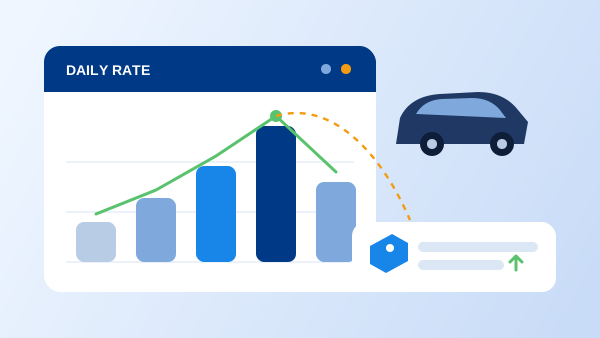
Give each vehicle class one base rate, then express seasons as multipliers — e.g. low ×0.8, shoulder ×1.0, high ×1.3, peak ×1.6. Adjusting one base rate later re-prices the whole year consistently.
-
3
Layer length-of-rental and lead-time rules
Add tiered discounts for longer rentals and a small early-booking incentive. These run on top of the seasonal rate, so every quote reflects all applicable rules at once.
-
4
Add utilization triggers
Decide thresholds in advance — e.g. above 80% booked for a period, raise remaining-car rates 10–15%; below 40% inside two weeks, open a promotion. Pre-agreed rules beat improvised panic pricing.
-
5
Review weekly, adjust yearly
A 15-minute weekly check of upcoming utilization tells you which periods need a nudge. Once a year, rebuild the season map from fresh data. The software applies the rules; you only make the decisions.
What Changes When Pricing Goes Dynamic
More revenue from the same fleet
Peak days stop being sold at February prices. Even a conservative seasonal structure typically lifts revenue per car without adding a single vehicle — which matters more than any cost cut, because the fleet is already your biggest investment.
Low season stops being dead season
Deliberate low-season pricing and promotions win the price-shoppers who are actually booking in those months. Thirty euros a day is not a great rate — but it beats the zero an empty car earns.
Every channel quotes the same price
When rules live in the rate engine, the website, the phone quote, and the walk-in price all agree. No more customers waving a cheaper online screenshot at your counter staff.
Season boundaries stop causing disputes
Cross-season rentals are calculated day-by-day automatically, so the quote is fair, explainable, and identical no matter which employee produces it.
Pricing decisions become 15-minute reviews
Manual repricing is why most operators leave rates untouched all year. With rules automated, staying dynamic costs you one short review a week — and if you're still weighing up platforms, our guide to car rental software costs covers what that automation should cost.
The Takeaway
Dynamic pricing for a car rental business is not algorithmic wizardry — it's a season map built from your own data, multipliers per vehicle class, discounts for long rentals and early bookings, and utilization triggers you decided on in advance. Set the rules once, let your rate engine apply them to every quote, and spend fifteen minutes a week steering. The operators earning the most per car aren't the ones with the biggest fleets — they're the ones whose prices move when demand does.
Frequently Asked Questions
Dynamic pricing means your daily rates change based on demand signals instead of staying fixed year-round. For an independent rental operator, that usually means rates that move with the season, how booked-out the fleet already is, how long the rental is, and how far in advance the customer books. It does not require airline-style algorithms — a well-structured set of seasons, multipliers, and length-of-rental discounts captures most of the benefit.
Yes — arguably more than large ones. A small fleet has no spare cars: selling out at a low rate during peak season is revenue permanently lost, and empty cars in low season earn nothing while still costing insurance and depreciation. Even a simple three-season rate structure with a peak-period uplift typically outperforms a single flat rate, and rate management software makes it maintainable without a revenue team.
Set your seasonal calendar once a year, then review actual performance weekly or bi-weekly during your booking season. The weekly review is short: check utilization for the coming weeks, nudge rates up on nearly sold-out periods, and consider promotions for weak ones. With software applying the rules automatically, the review is a 15-minute decision, not an afternoon of editing rate sheets.
The fairest method is day-by-day calculation: each rental day is charged at the rate of the season it falls in, so a booking that spans the end of high season and the start of shoulder season pays the high rate only for the high-season days. Doing this by hand is error-prone, which is why it should be handled automatically by your reservation system's rate engine.
Travelers already expect prices to vary with dates — every airline, hotel, and major rental brand they buy from works that way. What loses bookings is not seasonal pricing but inconsistency: quoting one price on the phone and a different one online, or surprising customers with recalculated totals later. As long as the quoted price is instant, consistent across channels, and honored, seasonal rates read as normal.