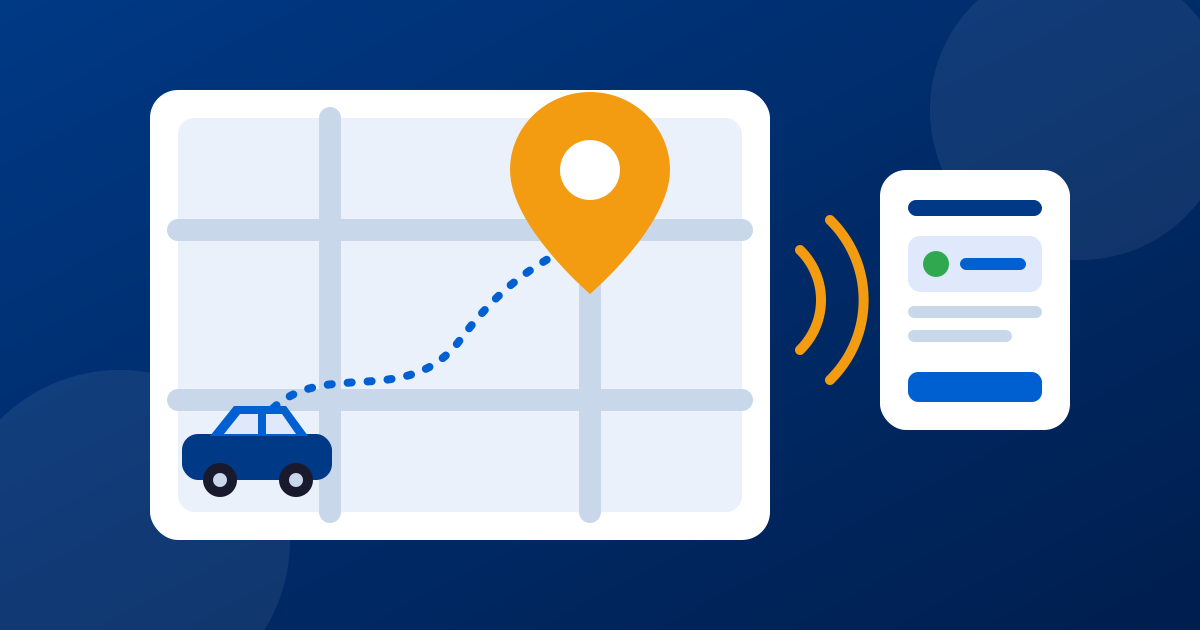
A rental car tracker tells you where a vehicle is. It does not automatically give you the right to use that information however you like. This guide is for agency owners and fleet managers deciding whether to put GPS in their cars. It covers the device types, what the first year costs, and the state rules that catch agencies out. If you are a renter looking for a tool that tracks rental prices, this is not that guide.
Short answer: a rental car tracker is worth adding when theft, non-return or high-value cars are a real risk, and you can start with only those units. Budget for a device plus a monthly plan: at an illustrative $100 and $10 a month, that is $220 per car in the first year. Tell renters in your agreement, but do not stop there, because California limits when you may use the data at all and New York bars using GPS information to set fees. Car Rental Solutions has no GPS hardware or live map; a tracker runs in its own app beside your rental software.
Types of Rental Car Tracker
Most devices sold for rental fleets fall into three groups. The trade-off is simple: the easier a tracker is to install, the easier it is for a renter to remove.
| Type | Installation | Strength | Weak point |
|---|---|---|---|
| OBD-II plug-in | Plugs into the diagnostic port in minutes | Easy to move between cars; some report odometer or engine data | Easy for a renter to find and unplug |
| Hardwired | Wired to the car's power, usually by an installer | Hidden and harder to remove; better for theft and non-return | Installation cost, and removal when you sell the car |
| Battery-powered | Placed in the vehicle, no wiring | Works without the car's power; useful as a backup device | Needs charging and usually reports less often |
Whichever you choose, look for the alerts that matter in a rental: movement after hours, power disconnected, and device names you can set to your unit numbers.
When a Tracker Is Worth It
Consider a tracker when theft or non-return is a real risk for your market, when you rent high-value vehicles, or when you take renters you cannot easily vet. You can start with those units only and leave the rest of the fleet as it is.
Software alone may be enough if you rent mostly to known customers, check licenses, take deposits and inspect cars at pickup and return. Most daily questions are about status (what is out, what is late, what is due for service), and a GPS dot does not answer those. The fleet management page compares what the software tracks with what GPS adds.
What a Rental Car Tracker Costs
You usually pay twice: once for the device, then a monthly plan for the cellular connection and app. Some vendors sell one-time devices with no monthly plan, so compare the total over the time you expect to keep the car, not the first invoice.
The table below is a worked example with illustrative figures, not market prices: a $100 device, a $10 monthly plan and a $55 daily rate. Get real quotes for your fleet. Installation is not included.
| Tracked units | Devices | 12 months of service | First-year total | Rental days to cover it |
|---|---|---|---|---|
| 1 car | $100 | $120 | $220 | 4 |
| 3 high-risk cars | $300 | $360 | $660 | 12 |
| 5 cars | $500 | $600 | $1,100 | 20 |
| 10 cars | $1,000 | $1,200 | $2,200 | 40 |
| 25 cars | $2,500 | $3,000 | $5,500 | 100 |
After the first year, the same example costs $120 per car, a little over two rental days at $55. Tracking only the three cars that worry you most costs 30% of tracking all ten.
State Rules: Why Disclosure Is Not Always Enough
The common advice is to put a GPS clause in your agreement. That is necessary, but in some states it does not settle what you may do with the data. California's statute lists the allowed uses, and it has no general exception for a renter who agrees in the contract.
| What you want to do | California (Civ. Code § 1939.23) | New York (GBL § 396-z(13-a)) |
|---|---|---|
| Find a car reported stolen, abandoned or missing | Allowed after the renter or police report it, or once you discover it is stolen or abandoned. If stolen, you report it to police | Not barred. The rule covers charges and preserves costs to recover a lost, misplaced or stolen vehicle |
| Find an overdue car | After 24 hours, with the initialed advisement in the agreement and 24 hours' notice by phone and electronically; or after one week | Not addressed by this rule. Ask your attorney |
| Charge for speeding | No. Tracking to impose fines or surcharges is prohibited | No. GPS information cannot determine or impose fees |
| Charge for leaving an allowed area | No fines or surcharges from tracking. A geofence may detect a car leaving the country if the agreement does not allow it | No. GPS information cannot determine or impose fees |
| Read return time, mileage and fuel | Allowed for the date and time the car leaves and returns, total mileage and fuel level, and only for that purpose | Not addressed, except that GPS information cannot set charges for the driver's use |
| Watch a renter's live location | No, outside the listed exceptions | Not addressed by this rule. Ask your attorney |
California adds a paperwork duty: when tracking is activated under these exceptions, keep a record with the rental agreement, the return date and the activation date and time, for at least 12 months, and provide it if the renter asks.
Other rules to know:
- Connecticut. A rental company charged $150 each time GPS showed a car at 80 mph or more for two minutes. The state Supreme Court treated the fee as a penalty and a violation of the state's unfair trade practices law; a hearing officer had put the actual wear at closer to 37 cents.
- Rhode Island. It is an offense to place or use a tracking device in a vehicle to monitor its operator or occupants without their consent, according to the National Conference of State Legislatures (NCSL).
- Other states. NCSL counted at least 26 states and D.C. with laws on private use of location tracking devices as of September 2022. Many target tracking a person without consent, and exceptions vary.
- Federal. The FTC calls geolocation data sensitive and says companies with legitimate access to sensitive data must use it only for the reasons they collected it.
This section is general information, not legal advice. Laws change, and they differ by state and by city. Confirm the rules for each location with your attorney before you install a device or change your agreement.
What to Tell Renters
Whatever your state requires, a clear notice protects you in a dispute. Have your attorney review the wording, then cover these points in the agreement:
- That the device exists. Say the vehicle has a GPS or tracking device, in plain words and outside the fine print.
- What it collects. Location, movement, mileage, or anything else your device records.
- Why you use it. Name the purposes, and keep them to what your state allows.
- Who can see the data, and how long you keep it. Limit access to the staff who need it and set a retention period.
- What it will not be used for. If you do not charge fees from tracker data, say so. It answers the question renters are likely to ask.
Train counter staff to answer the same way, because California also requires the advisement orally when the rental is completed in person or by phone. With agreement software you can edit your terms once and every new contract carries the clause. What a rental agreement should include covers the rest of the document.
How a Tracker Fits With Rental Software
We should be plain about this: Car Rental Solutions does not include tracking hardware or show vehicles on a map. A tracker runs in its own app. The two answer different questions, so they sit side by side.
| Question | Rental software | Tracker |
|---|---|---|
| Is the car on rent or overdue? | Yes, from the contract and the return date | No. It sees movement, not contracts |
| Can it be booked for these dates? | Yes, from confirmed reservations and open contracts | No |
| Where is the car right now? | No | Yes, where the law lets you look |
To keep them in step, name each device with the same unit number and plate you use in your rental software. When a car shows as overdue on your dashboard, you know which device to check and which contract applies, and you can follow your state's rule before you open the tracker.
Car Rental Solutions starts at $69.95 a month plus a $197 one-time setup fee. Contracts and fleet tracking start with Option B, at $99.95 a month plus a $297 setup fee. Every plan has a 14-day free trial with no credit card, and most agencies go live in about five days. See pricing for what each plan includes.
Frequently Asked Questions
Some do, but not all. Agencies add them mainly to protect against theft and non-return, and newer cars may also have connected systems from the manufacturer. If you run an agency, check what your own vehicles already collect before you add a device.
You pay for the device and usually a monthly service plan. As an illustration only, a $100 device with a $10 monthly plan costs $220 per car in the first year and $120 a year after that, or about $2,200 in the first year for 10 cars. Installation is extra, and real quotes vary by device and vendor.
Plan on it. Disclose the device, what it collects and why in your rental agreement, and check your state's rules. California goes further and requires a specific advisement, initialed by the renter, before you may activate tracking on an overdue car.
Not in California or New York: California bars using electronic surveillance technology to track a renter in order to impose fines or surcharges, and New York bars using GPS information to determine or impose costs, fees, charges or penalties for the driver's use of the car. In Connecticut, the state Supreme Court treated a $150 GPS speeding fee as an illegal penalty. Elsewhere, ask your attorney first.
It depends on the state. California allows it 24 hours after the contracted return date if the agreement advised the renter, the renter initialed it, and you give 24 hours' notice by telephone and electronically, or one week after that date without those steps. You must also keep an activation record for at least 12 months. New York's rule does not limit charges to recover a lost, misplaced or stolen vehicle. Check your own state's law before you act.
No. Car Rental Solutions does not include tracking hardware or show vehicles on a map. It shows each car's status, such as on rent, overdue or due for service. A tracker runs in its own app, so use the same unit number in both systems.
Sources
- California Civil Code § 1939.23, FindLaw (current as of January 1, 2026)
- New York General Business Law § 396-z, subdivision 13-a, New York State Senate
- Anita Ramasastry, Tracking Every Move You Make, FindLaw (on the Connecticut Supreme Court ruling)
- Private Use of Location Tracking Devices: State Statutes, National Conference of State Legislatures (September 2022)
- Cars & Consumer Data: On Unlawful Collection & Use, Federal Trade Commission (May 2024)