A Two-Hour Rental Breaks a Daily-Rate System
Car rental software assumes the rental starts today and ends tomorrow. Motorcycle and scooter rentals often start at ten in the morning and end at two in the afternoon. That single difference — a rental priced by the hour rather than by the day — is where most two-wheeler operators first discover their platform was built for a different vehicle.
The workarounds are familiar to anyone who has tried it. Short rentals get quoted verbally and entered as a full day with a manual discount. Helmets get handed out and hopefully handed back, tracked on a clipboard. The licence gets photographed on someone's phone because there is no field for an endorsement class. And when a bike comes back with a scuffed exhaust, there is no check-out photo to compare it against.
This guide covers what motorcycle rental software has to do differently, which of those differences actually matter to revenue, and how to decide whether two-wheelers belong on the same platform as the rest of your fleet.
What Motorcycle Rental Software Has to Do Differently
The core reservation logic is the same as any rental platform: availability, a rate, a customer, a contract, a deposit. What changes is the shape of each one. Motorcycle and scooter rental software earns its keep on five specifics: rate ladders that start at an hour rather than a day, licence class and endorsement capture, helmet and gear as tracked inventory, deposits sized to a vehicle that is easy to drop, and photo-based damage records instead of a body diagram.
None of those are exotic features. They are ordinary rental mechanics applied to a vehicle with a different rental pattern and a different risk profile. The reason generic car software struggles is not that it lacks power — it is that its defaults are wrong at every one of those five points, and defaults are what your counter staff actually use under pressure.
The Five Features That Matter Most
1. Hourly, half-day, and full-day rate ladders
A rate engine needs to price a two-hour rental, a four-hour rental, and a full day as distinct products, ideally with the hourly rate stepping down as duration grows. If the shortest unit the software understands is one day, every short rental becomes a manual override — and manual overrides are where margin quietly disappears.
Seasonal adjustment matters here too. In tourist markets, a scooter rented in August is not the same product as the same scooter in February, and the rate ladder should shift with the season automatically rather than through a bulk edit somebody remembers to do.
2. Licence class and endorsement capture
A car rental takes a driving licence. A motorcycle rental frequently needs a specific endorsement or licence class, and the threshold moves with engine displacement and with the country you operate in. The software should store the licence image, the class, and the expiry against the reservation, and make it obvious to counter staff when a rider is not cleared for the bike they booked.
This is a compliance and insurance question as much as an operational one. A rental handed to an unendorsed rider is a problem that surfaces at the worst possible moment.
3. Helmet and gear as tracked inventory
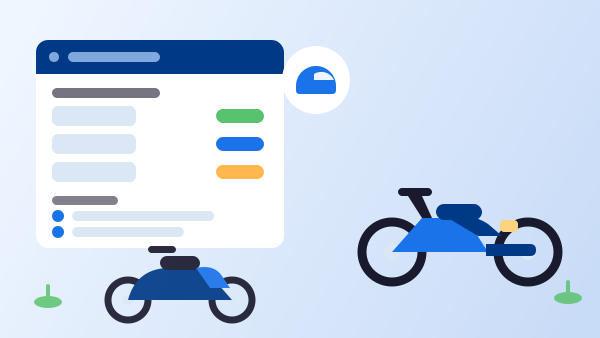
Helmets, jackets, gloves, and luggage cases are sized items that leave the shop and are supposed to come back. Treating them as a flat "add-on" checkbox loses the detail that matters: which helmet, what size, on which booking. Software that records the specific item against the reservation turns a recurring shrinkage problem into a traceable one, and lets gear be selected and paid for during checkout rather than negotiated at the counter.
4. Deposits that reflect how bikes get damaged
A motorcycle does not need a collision to cost money. A low-speed drop in a car park scratches bar ends, bends a lever, and scuffs an exhaust — a few hundred in parts on a bike that never left second gear. Deposits need to be collected online at booking and sized to the class of machine, not to a generic vehicle category inherited from the car side of the business.
5. Photo-first damage documentation
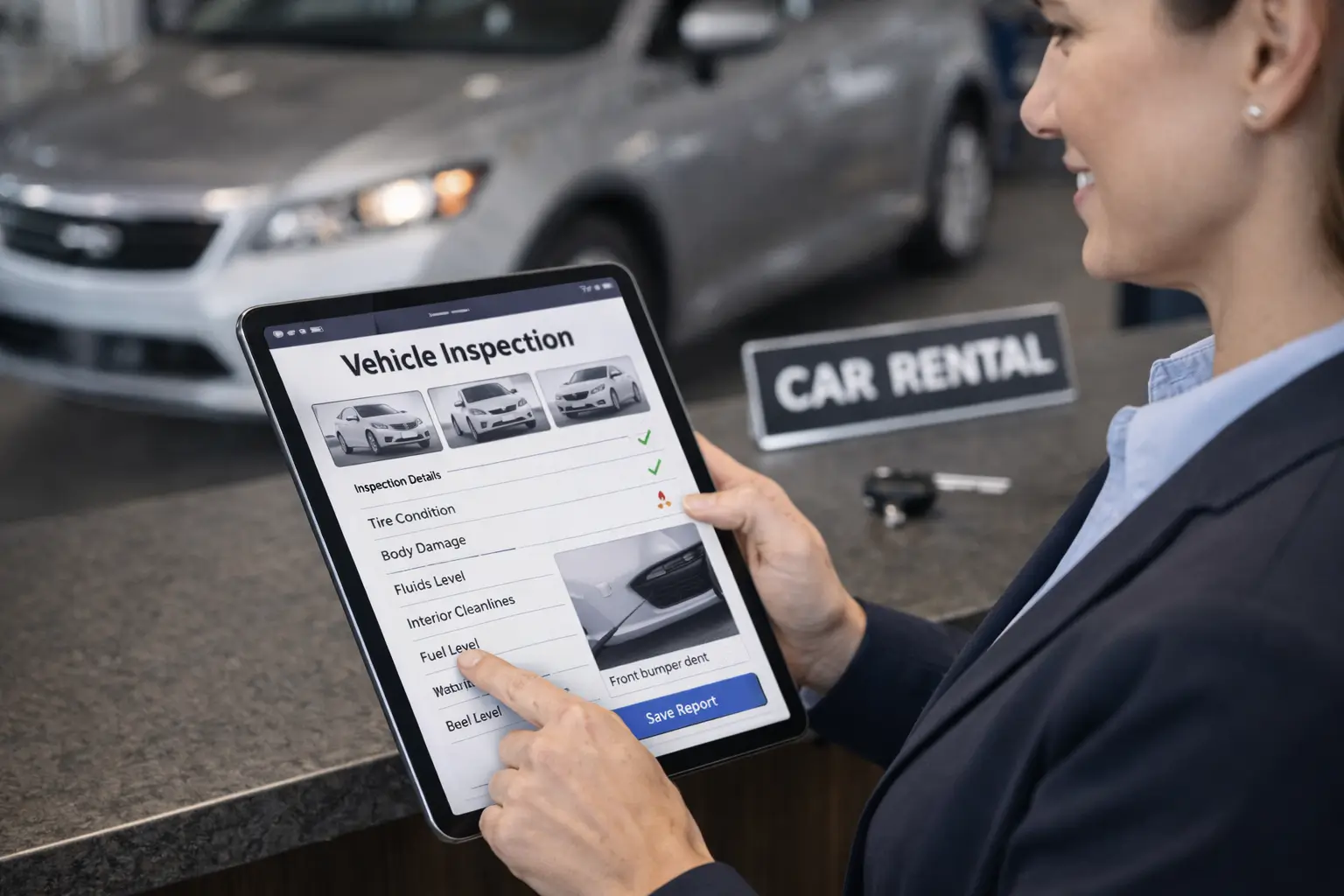
The standard car condition diagram — four doors, hood, trunk — simply does not describe a motorcycle. What works is a fixed photo sequence at both ends of the rental: both sides, tank, handlebars or fairing, exhaust, both wheels. Because a bike has almost no bodywork to conceal damage, photographic records are unusually conclusive, which is why digital inspections pay off faster on two wheels than on four.
One feature you can largely skip: mileage allowance and overage billing. It is standard in car and RV rental, but scooter and motorcycle rentals in city and tourist markets are usually time-limited rather than distance-limited, and a mileage cap adds friction to a booking that a rider expects to be simple. Fuel policy still matters; mileage tiers usually do not.
"A motorcycle rental is a car rental measured in hours, secured against a drop rather than a crash, and documented in photographs rather than on a diagram."
Mixed Fleets: Cars and Two-Wheelers on One Calendar
Plenty of operators add scooters or motorcycles to an existing car fleet — a coastal agency adding scooters for summer, a city operator adding commuter bikes. The instinct is to find a dedicated two-wheeler booking tool, since the requirements above are genuinely specific. In practice that usually means a second calendar, a second login, and a customer who rented a scooter in July showing up as a stranger when they book a car in December.
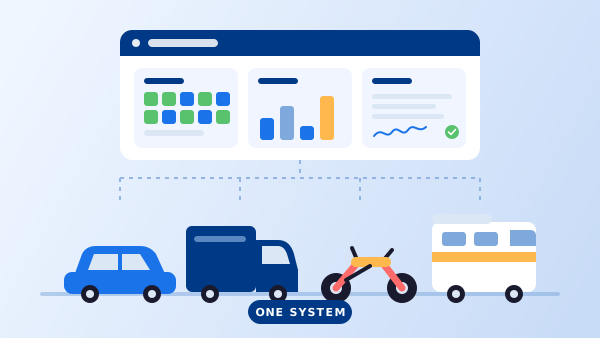
The better test is not "is this tool motorcycle-specific" but "is this rate engine flexible enough to price by the hour, and can the vehicle record carry gear and licence-class fields." If the answer is yes, one platform handles both, and availability, deposits, and customer history stay in one place. That is the same argument this site's guide to running a mixed fleet on one system makes for vans, trucks, and RVs — the cost of a second system is rarely the subscription, it is the gap between two records of the same customer.
Contracts are worth checking specifically. A motorcycle rental agreement usually carries clauses a car agreement does not — protective gear requirements, pillion passenger terms, off-road exclusions — so the agreement templates need to vary by vehicle class rather than being one document for the whole fleet. The same applies to the solutions view of your business: segments differ in their paperwork long before they differ in their software.
Setting It Up in 5 Steps
-
1
Build the hourly rate ladder
Define hourly, half-day, and full-day rates per bike class, with the hourly rate stepping down as duration grows, then layer seasonal pricing for peak months.
-
2
Set licence requirements per class
Record which licence class or endorsement each bike class requires, so the reservation flags a mismatch before the rider is at the counter.
-
3
Load gear as selectable inventory
List helmets by size, jackets, gloves, and luggage as items a renter can add during checkout and the counter can check out against the booking.
-
4
Set deposits by bike class
Configure online deposits sized to each class of machine, collected at booking rather than requested on the forecourt.
-
5
Standardise the photo sequence
Fix the same set of angles for every check-out and check-in so condition records are comparable across bikes, staff, and seasons.
What Changes When the Software Fits the Vehicle
Short rentals stop being manual
A two-hour booking prices itself correctly online instead of being entered as a discounted day, which removes both the counter delay and the margin leak.
Licence problems surface before the rider arrives
Endorsement requirements checked at booking mean the awkward conversation happens by email, not at the front of a queue on a Saturday morning.
Gear stops walking away untracked
A helmet recorded against a specific booking is a helmet you can ask about. One handed out from a shelf is a replacement cost nobody can attribute.
Drop damage becomes billable instead of absorbed
Deposits sized to the machine, paired with photographs from both ends of the rental, turn predictable low-speed damage into a claim you can actually make.
A seasonal fleet flexes without more admin
Operators who run bikes only in peak season can scale units up and down on the same calendar and customer database they already use for cars, as the fleet management side of the platform handles both vehicle types identically.
Frequently Asked Questions
You can, but the pricing model is usually the first thing to break. Most car rental platforms are built around a flat daily rate, while motorcycle and scooter rentals are commonly sold by the hour, the half day, or the full day. If the rate engine cannot express an hourly ladder, staff end up quoting short rentals by hand. Licence endorsement capture, gear add-ons, and per-unit damage documentation are the other three gaps that show up quickly.
Motorcycle rentals often require a specific licence class or endorsement that a standard driving licence does not cover, and the requirement varies by country and by engine displacement. Software should capture the licence image and the endorsement details at booking or check-in, store them against the reservation, and let staff see at a glance whether the rider is cleared for the class of bike they reserved.
Helmets are the near-universal one, and many operators also rent jackets, gloves, armoured trousers, luggage cases, phone mounts, and rain gear. Because gear is sized, it is closer to inventory than to a simple checkbox: software should let a renter select gear during checkout and let the counter record which specific items went out, so a missing helmet is traceable to a booking.
The car-style diagram with four doors and a hood does not map onto a motorcycle, so the practical approach is photo-first. Capture a fixed set of angles at check-out and check-in — both sides, the tank, the fairing or handlebars, the exhaust, and both wheels — timestamped against the reservation. Scratched bar ends, scuffed exhausts, and dropped-bike damage are visible in photos and very hard to argue about later.
For most mixed operators, yes. Running a separate two-wheeler tool means two calendars, two customer records, and two places to check availability for a customer who rents a scooter in summer and a car in winter. The requirement is not a separate system but a rate engine flexible enough to price by the hour and a vehicle record that can carry gear and licence-class fields.