
Operations
Car Rental Fleet Management: A Practical Guide
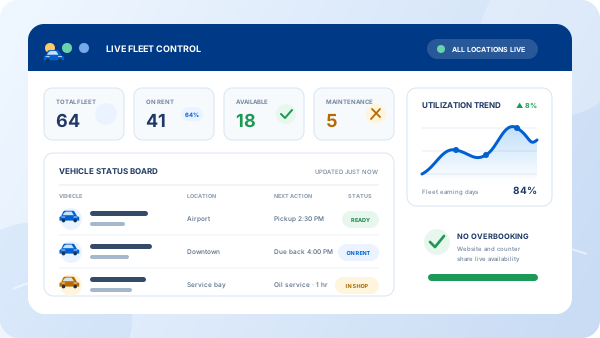
Your fleet is your single biggest investment and your only real source of revenue. Yet many agencies still manage it with spreadsheets and gut feel—overbooking one class while another sits idle. Fleet management is the discipline of keeping every vehicle earning as many days as possible, and it is the fastest lever most rental businesses have to improve margins.
What is fleet management in car rental? It is the work of tracking every vehicle's status (available, on rent, due back or in maintenance), keeping availability accurate across your website and counter, scheduling maintenance, and using utilization data to decide which vehicles to buy, price, move or retire. The goal is to keep as many vehicles earning as many days as possible.
What fleet management actually covers
Good fleet management ties together four things: real-time availability, maintenance and downtime, utilization data, and multi-location logistics. When those live in one system, you always know what is on rent, what is available, what is in the shop, and where demand is going. When they live in separate tools, you get blind spots—and blind spots cost money.
See your whole fleet in one screen
Real-time availability, maintenance control, and utilization insights in one platform built for rental operations.
Explore fleet management softwareKill idle days with real-time availability
Every day a vehicle sits unbooked is revenue you never recover. The fix is visibility: a live view of your whole fleet so you can shift inventory, adjust pricing, or promote an underused class before the day is lost. Modern fleet management software calculates availability from real reservations and open contracts, so what you see is what is actually rentable.
Prevent overbooking automatically
Overbooking damages your reputation and your margins. When your website booking engine and your counter draw from the same availability data, customers can only book what exists. That single source of truth is the backbone of a healthy reservation system.
Use utilization data to buy and price smarter
Utilization—the share of days your vehicles are actually rented—tells you which classes to expand, which to retire, and where to adjust pricing. Agencies that review utilization weekly make better purchasing decisions and squeeze more revenue from the fleet they already own. For practical tactics, see our guide to improving fleet utilization.
Scale across locations without losing control
As you add branches, one-way rentals and inter-branch transfers become daily reality. A system that shares availability across every location—see our multi-location software—keeps head office and each branch working from the same numbers.
How to calculate fleet utilization
Utilization = days rented ÷ days available × 100.
Example: a 20-car fleet over a 30-day month has 600 vehicle-days. If cars were on rent for 420 of them, utilization is 420 ÷ 600 = 70%. Some operators exclude maintenance days: if 30 of those 600 days were in the shop, utilization is 420 ÷ 570 = 73.7%. Pick one method and use it every week so the trend stays comparable.
Fleet KPIs worth tracking weekly
| KPI | How to calculate it | What it tells you |
|---|---|---|
| Utilization | Days rented ÷ days available | Whether a vehicle class is under- or over-supplied |
| Revenue per available vehicle-day | Rental revenue ÷ vehicle-days available | How hard each car works, combining price and utilization |
| Average daily rate | Rental revenue ÷ days rented | Whether your pricing holds in each season |
| Downtime days | Days in maintenance or out of service | Where repairs or slow turnarounds cost you rentals |
| Overbookings | Reservations with no vehicle at pickup | Whether your availability data can be trusted |
The takeaway
Fleet management is not a back-office chore; it is a revenue strategy. Get real-time visibility, prevent overbooking, and act on utilization, and the same fleet will simply earn more.
Fleet management FAQs
What is a good fleet utilization rate for car rental?
It varies by market and vehicle class, but higher is better—every idle day is lost revenue. The point of tracking utilization is to spot underused classes and locations and act on them, rather than hitting a single universal number.
How does software prevent overbooking?
It calculates availability from confirmed reservations and open contracts, and uses that same data for your website and counter, so customers can only book vehicles that are genuinely available.
What is fleet management in car rental?
Fleet management in car rental is the work of tracking every vehicle's status (available, on rent, due back or in maintenance), keeping availability accurate across the website and counter, scheduling maintenance, and using utilization data to decide which vehicles to buy, price, move or retire.
How do you calculate fleet utilization?
Divide days rented by days available and multiply by 100. A 20-car fleet over 30 days has 600 vehicle-days; 420 rented days gives 70% utilization.